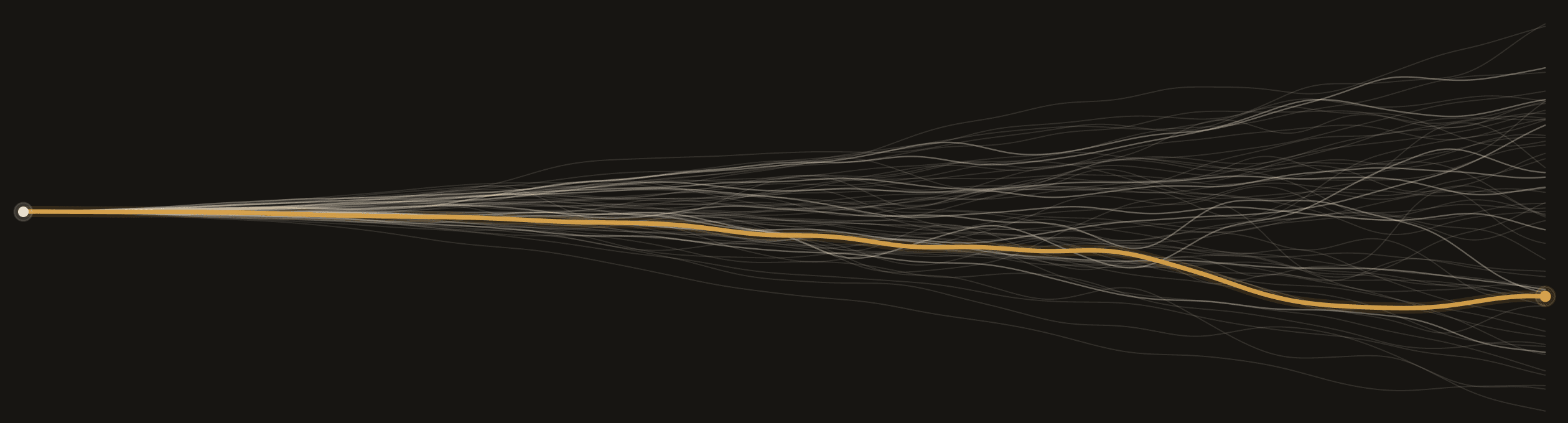
For most of my life, I treated determinism as an abstract question, the kind that belongs in the same drawer as consciousness, death, and the beginning of the universe. Interesting, but far away. Recently I have come to think that this was a mistake. If determinism is true, it is not far away at all. It reaches into the most intimate thing a person does: the experience of making a choice.
Start with something almost too obvious to say. Events do not simply happen. They happen because something caused them. A glass falls because someone knocked it over. A tree grows because sunlight, water, and a long chain of chemistry allow it to. Every explanation we ever give for anything in the physical world is, in the end, an appeal to causes.
Now take one more step. Your brain is a physical object. Every thought you have corresponds to electrical activity across billions of neurons. Those neurons fire because charged particles move across their membranes. Those particles move because of chemical gradients, and those gradients exist because of molecular interactions governed by the same laws that govern everything else. Nothing in that chain asks for an exception, and nothing in it gets one.
Notice that I have said nothing about free will. I have only followed causation to where it leads. And yet something already feels wrong. Every morning I wake up to what appears to be a decision. Get up, or snooze the alarm. Work, or drift. These questions feel open. They feel undecided. They feel as though several futures genuinely lie in front of me, waiting.
The Single Line
But if every event has a cause, this cannot literally be true. Let me say precisely what I mean, because the word “determinism” is often used loosely. Determinism is the claim that the complete state of the universe at any moment, together with the laws of nature, fixes exactly one state at every later moment. Not a range of possibilities. Not a set of probabilities. One state. The future is not a menu; it is a single line, and the present already points down it. This was the picture the mathematician Pierre-Simon Laplace made famous two centuries ago: a mind that knew the position and motion of every particle in the universe would find nothing uncertain, and the future would lie before it exactly like the past.
Two clarifications, before the discomfort sets in properly. First, determinism is not a claim about prediction. A system can be completely determined and still be impossible to predict. We will come back to this, because it turns out to matter enormously. Second, determinism is not fate. Fate says the outcome arrives no matter what you do. Determinism says something different, and stranger: what you do is itself one of the determined things, and the outcome depends on it. Hold that distinction. The entire second half of this essay hangs on it.
So the claim on the table is this: there are not two futures waiting to be selected tomorrow morning. There is one. Whichever choice I eventually make, whether I spend the evening working or wasting time, whether I build something with my life or let it drift, was already implicit in the state of the universe long before I became aware of choosing it.
Before accepting that, I owe the claim an honest stress test. Because there is a well-known objection, and it comes from physics itself.
What the Physics Actually Says
Quantum mechanics is usually presented as the discovery that the universe is random at its foundations, that at the smallest scales nature rolls dice, and no amount of information could tell you how they will land. If that is right, determinism is simply false, and this essay ends early.
But that is not actually what physics says. It is what one reading of physics says. The central equation of quantum mechanics, the one that describes how a system evolves from moment to moment, is itself perfectly deterministic. Randomness only appears to enter at the moment of measurement, and what “measurement” actually is remains one of the deepest unsolved problems in physics. Faced with that gap, physicists have built several complete, self-consistent versions of quantum theory. In some of them, the randomness is real: the universe genuinely rolls dice. In others, taken just as seriously and defended by just as capable people, the randomness is an illusion of our ignorance, exactly the way a coin flip only looks random because we cannot track the force and spin closely enough. In those versions, every particle follows a single definite path, and the dice-rolling appearance comes from information we can never access. The remarkable thing is that these pictures make identical predictions in the laboratory. Physics has not settled which one describes our world, and it may never be able to.
So the question of whether anything is truly random is open, and taking the deterministic reading is not naive. It is one of the live options. I will take it. From here on: the universe is fully determined, one fixed history, no exceptions, all the way down and all the way up. Including up into the skull.
The Amplifier in the Skull
Now the brain, because this is where the argument earns its keep.
A neuron is not a dial; it is a switch. Signals arriving at it either push its voltage past a threshold or they do not. Below the threshold, nothing. Past it, the neuron fires completely, all or nothing. This means a neuron is an amplifier of tiny differences. Right at the threshold, a difference of a few millionths of a volt is the difference between firing and silence, between a signal that propagates and one that dies.
And the brain supplies exactly those tiny differences, constantly. The channels that let charged particles through a neuron’s membrane do not open and close smoothly; they flicker, jostled by heat, one molecule at a time. Careful measurements have shown that this flicker is large enough to shift when, and whether, a neuron fires. More striking still: the timing of a spike is decided not by the many channels open at its peak, but by the small handful open at the exact moment the threshold is crossed. At the decisive instant, the margin is thinnest.
Then the amplification compounds. Neurons in the cortex are wired into dense loops, each one exciting and inhibiting others, which feed back on the first. In 1996, theorists showed that networks built this way naturally fall into a chaotic regime, meaning the network’s state is extraordinarily sensitive to small differences in its starting conditions. Change whether one neuron fires one spike, and the difference does not fade; it spreads and grows, until within moments the whole network is doing something measurably different than it otherwise would have. A change too small to matter becomes, milliseconds later, a change too large to miss.
One might hope quantum randomness hides here, that the dice-rolling of particles, if it exists, is what seeds these fluctuations, smuggling genuine openness into the brain. The physics is unkind to this hope. The brain is warm and wet, and in warm, wet places delicate quantum states are destroyed by collisions with the environment almost instantly. The calculations put their survival at a thousandth of a trillionth of a second or less, while a neuron takes a full thousandth of a second to fire. Whatever is jostling those channels, by the time it matters biologically, it is ordinary thermal motion: fully determined, in our picture, down to the last decimal.
So here is what the science hands back to the philosophy, and it is a strange gift. The brain is completely determined, and radically unpredictable. Not unpredictable because we lack good instruments, but unpredictable in principle: a chaotic system’s future cannot be known without knowing its present state perfectly, to infinitely many decimal places, and no measurement can do that. Determinism survives intact. Predictability does not. The future is fixed, and no one, no scientist, no machine, no imaginary demon, can read it in advance.
Fixed, but not written down anywhere. That distinction is about to do all the remaining work.
Fixed Is Not Known
Here is the objection I could not get past for a long time, and I suspect I am not alone. If the outcome is already fixed, why do anything? Why not snooze every alarm, skip the work, let the days go slack, since where I end up was settled before I was born?
The objection sounds airtight. It contains two errors, and finding them changed how I understand my own life.
The first error: “the outcome is fixed” quietly becomes “the outcome is known,” and those are different properties. Fixed means there is exactly one way it will go. Known means someone has access to that answer in advance. Determinism gives us the first and, as we just saw, structurally denies everyone the second, including me, about my own future. I do not secretly know that things turn out fine whether or not I get up. I know nothing of the kind. The only way the answer to “what does my life become” ever gets produced is by the living of it, in order, in real time. There is no advance draft. For a chaotic system like a brain, there is not even a shortcut: no calculation reaches the outcome faster than the process itself. The universe computes my choice exactly once, exactly now, exactly through me. In the most literal sense, my decision has not been thought of already, by anything. It gets thought here.
The second error is deeper. Why act, if the outcome is the same either way? But determinism never said the outcome is the same either way. That is fate, and fate is a different and frankly incoherent theory. Determinism says the outcome is a function of what happens before it, and what happens before it includes me. Tomorrow is not sitting at the end of the week indifferent to how I spend the days. Tomorrow is whatever the days entail. If the fixed future contains the version of my life I want, it contains it because it also contains the mornings I got up, the hours I worked, the alarms I did not snooze. Skip those, and I have not slipped through some loophole to the same destination. I have changed the input, and the function returns a different value. There was never an outcome waiting for me regardless of the path. The path is what the outcome is made of.
And now the objection eats itself, which is the most beautiful part. Suppose I hear all this and think: fine, then let determinism decide. I will stay in bed and let the fixed future happen. But that thought is not a move made from outside the system. It is one more event inside it, one more cause, weighed against my habits, my fears, my ambitions, everything I am, and it does not get to stand apart and pull levers. If I am the kind of person whose resolve dissolves on contact with a philosophical argument, then that dissolving was always part of the chain, and my life will show it. If I am the kind of person in whom this argument produces the opposite, a kind of clarity, the realization that my effort is not decoration on a finished future but raw material of the only future there is, then that too was always coming. Either way, there is no neutral ground to test it from. Whatever I do next is not a test of determinism. It is determinism, showing me in real time which kind of person I turn out to be.
What Freedom Names
So: am I really making choices? I want to answer honestly, without softening either half.
Could I have done otherwise, with everything about the past held exactly the same? No. Rerun the universe from an identical state and I do the identical thing, every time. If that is what choice requires, nothing has ever chosen anything.
But I no longer think that is what choice requires, because I no longer think that was ever a coherent thing to want. An action untethered from everything I am, floating free of my history, my values, my reasons? Such an act would not be freedom. It would be noise, and I would be its bystander, not its author. What I actually wanted, when I wanted free will, was for my deliberation to matter: for the weighing, the wanting, the deciding to be real work with real consequences, not a film playing over machinery that had already moved on. And that, it turns out, is exactly what determinism delivers. The weighing is not commentary on the causal chain. It is a link in it, a strange and remarkable kind of link, one that contains a model of its own possible futures and feeds that model back into what it does. A rock rolling downhill is determined. So am I. The difference is that no part of the rock is asking where it should roll, and the asking, in me, is one of the forces that settles the answer.
This, I think, is what freedom actually names. Not an exemption from causation; nothing has that. Freedom is what causation looks like from the inside, at the rare places in the universe where the chain runs through something that represents its own options, weighs them, and cannot be bypassed on the way to the result. The future was always fixed. It was never written anywhere, and it will not write itself. It gets written here, once, through the deliberation I am carrying out this moment. That is why, tomorrow morning, when the alarm sounds and the day feels open, I will not treat that feeling as a lie. It is the truthful texture of being the place where the outcome is decided. There was only ever going to be one future. It was only ever going to arrive by way of me caring about it.